The Philco series lasted 3 seasons on ABC. The show never achieved the ratings success of the Kraft Music Hall, in part because ABC was a smaller network of stations. To compensate, many radio stations not affiliated with any network were recruited to broadcast the show. They were shipped long-playing discs with instructions of how and when to play them. Unfortunately, many people complained that the sound quality was inferior to a live broadcast.
Sound engineer Mary Howard suggested that part of the problem was the local radio stations:
"Most stations play a hundred records a day, and they play every last one wrong. Take the new Crosby show. Everybody complains that Bing has lost his voice, that the recording is tinny and distorted. That's nonsense. Bing sings about as well as he ever did, and the recording is all right. It's the stations that play it wrong. The grooves in a record are cut at varying angles and depths with styli of varying sizes. Records have to be played back with corresponding needles set for corresponding angles and sizes to fit the grooves. Until radio stations learn that, these big, nighttime transcribed shows are going to flop." (TIME, Dec. 30, 1946).
What follows is a list of the broadcasts, principal guests and songs sung by Bing from the first season of the Philco show. Accompanying Bing from the Kraft show was his announcer, Ken Carpenter, the John Scott Trotter Orchestra and the vocal group the Charioteers. The Charioteers left the show in March, 1947, and were replaced by Jud Conlon's Rhythmaires. Bing's frequent female vocalists included Lina Romay and Peggy Lee. Bing's boyhood idol, Al Jolson, joined Bing for 4 shows, always memorable. There was talk that Jolson might be signed as a regular for the following season, but Jolson instead took over Bing's old haunt, the Kraft Music Hall. Carroll Carroll, the principal writer of the Kraft Music Hall and inventor of the Bing Crosby persona, no longer wrote for Bing. Instead, the Philco show was written by Hal Kanter and Bill Morrow. An asterisk (*) beside a show indicates a particularly great show; an asterisk beside a song indicates a great Crosby vocal.
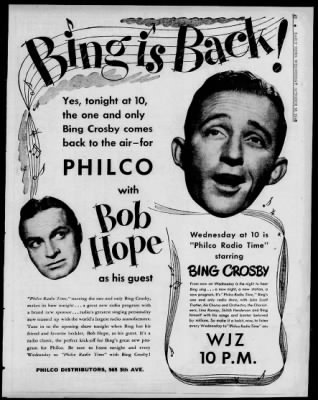
PHILCO RADIO TIME (10-16-46) w BOB HOPE, CHARIOTEERS (1st show)
I got sun in the morning; Moonlight bay (w Charioteers); Put it there, pal (w Hope); Cynthia's in love
"The first of Bing Crosby's $30,000-a-week transcribed series for Philco --
with Bob Hope as guest star -- was waxed last week, but ran two minutes overtime.
Producer Bill Morrow put it up to Philco: whose lines should he cut -- Crosby's or Hope's?
Philcomen went into a huddle, came out with a decision for audiences to applaud:
'Cut the commercial'." -- TIME (10-14-46)
In August the news was flashed around the earth the world's favorite baritone would do a series of transcribed broadcasts for Philco over the American Broadcasting Co. The pay would be the highest in radio ($24,000 a week with a percentage on additional stations which might bring it as high aa $30,000). The network would be the largest ever strung together for a commercial show (208 ABC stations, possibly 400 independents.) As the great day approached, the publicity mounted. The network renamed Wednesday Bingsday. Magazine ads blossomed like magnolias, recounting the story of the voice on which the sun never sets. The Crosby face, as symbolic of America as Churchill's cigar of the British Empire, peered forth from hundreds of newspaper ads to remind us Wednesday was the day. It was the greatest build-up since Bikini. By the time the first strains of "When the Blue of the Night" crept through our loudspeakers in the serene, relaxed unmistakable tones of the world's most nonchalant singer, it was a bit of an anticlimax. What were we all expecting -- the Apocalypse? It was just Crosby -- the same effortless voice you hear night and day from 10,000 Juke-boxes, the same velvet tones and perfect phrasing that emanate hour after hour via recordings from hundreds of Independent radio stations. Discounting the publicity, it was a darn good show. The cherry on this sundae was Bob Hcpe, another entertainer who haa reached such a peak of adulation that he can afford to relax. The two old friends, who go together like scotch and soda, insulted each other's waistline, hairline and baseball teams and wound up doing a duet called "Put Her There, Pal ." (John Crosby, Los Angeles Daily News, 22 Oct. 1946)
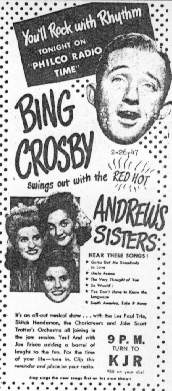
PHILCO RADIO TIME (10-23-46) w SPIKE JONES, CHARIOTEERS My heart goes crazy; Hawaiian love chant (Spike Jones); Love in bloom (w Jones); Surplus me (Lina Romay); All by myself*; Boardwalk in Atlantic City (Charioteers); The things we did last summer* PHILCO RADIO TIME (10-30-46) w LES PAUL TRIO, CHARIOTEERS I got the sun in the morning; South America, take it away; You are too beautiful; Bye and Bye (Charioteers); Route 66; Blue Skies PHILCO RADIO TIME (11-6-46) w SKITCH HENDERSON, RALPH MENDEZ Give me 5 minutes more; Kentucky Babe (w Charioteers); It's Only a Paper Moon; Road River Valley (Charioteers); You keep coming back like a song PHILCO RADIO TIME (11-13-46) w EZIO PINZA, CHARIOTEERS My heart goes crazy; Pretending; South America (w Lina Romay); Timber Trail (w Pinza); Little David (Charioteers); September song; Should I tell you I love you(After nearly 5 years as Bing's featured vocal group, the Charioteers performed with Bing on the radio for the last time perhaps because most of the remaining programs were to be recorded 'on the road' in Chicago and New York. Not even Ken Carpenter traveled with Bing for these broadcasts. The Charioteers were replaced by Judd Conlon's Rhythmaires.)PHILCO RADIO TIME (11-20-46) w BURL IVES, CHARIOTEERS Give me 5 minutes more; Bluetailed fly (Ives); That little dream got nowhere; A Man is a Brother to a Mule (Lena Romay); No Soup (Charioteers); Careless love (w Ives); Things we did last summer PHILCO RADIO TIME (11-27-46) w JUDY GARLAND * Old Buttermilk Sky; Gotta Get Me Somebody to Love*; Liza (Judy Garland); Wait Til the Sun Shines Nellie (w Judy); All By Myself*; You Keep Coming Back Like a Song* PHILCO RADIO TIME (12-4-46) w JIMMY DURANTE, CHARIOTEERS * A gal in Calico*; And then it's heaven*; Start each day with a song (w Durante); Didn't Old Pharoh Get Lost (Charioteers); Rumors are flying*; Crosby the well-dressed man; Blue skies (w Durante) PHILCO RADIO TIME (12-11-46) w JERRY COLONNA, CHARIOTEERS * Give me 5 minutes more*; Old buttermilk sky; If you were the only girl*; Why did I leave Wyoming (Colonna); It's a good day (w Peggy Lee); For you, for me, forevermore PHILCO RADIO TIME (12-18-46) w SKITCH HENDERSON, PEGGY LEE A gal in Calico; Rumors are flying; The old lamplighter; For Sentimental Reasons (Charioteers); Everything is moving too fast (w Lee); White Christmas PHILCO RADIO TIME (12-25-46) w SKITCH HENDERSON, CHARIOTEERS Adeste Fideles, The Christmas song, Jingle Bells (w Charioteers), White Christmas, Silent Night. The last half of the show was a performance of a Christmas play called "The Small One." (This show was repeated in 1947.) PHILCO RADIO TIME (1-1-47) w JOE FRISCO, PEGGY LEE, SKITCH HENDERSON A Rainy Night in Rio; And then it's heaven; Brother Bill (Charioteers); Baby, you can count on me (w Lee); The old lamplighter. The comedy skit with Frisco was a repeat from the 2 May 1946 Kraft show. Ken Carpenter announced that W. C. Fields would be Bing's guest next week. Fields died Dec. 25, 1946. PHILCO RADIO TIME (1-8-47) w MICKEY ROONEY, PEGGY LEE Zip-a-Dee-Doo-Dah (from Disney's "Song of the South"); Gotta get me somebody to love; What more can a woman do (Peggy Lee); Gal in Calico; For you for me forevermore PHILCO RADIO TIME (1-15-47) w AL JOLSON Rainy Night in Rio; April Showers (w Jolson); Rosey (w Jolson); Swanee (Jolson); Singing Philco commercial; The One I Love (w Jolson) PHILCO RADIO TIME (1-22-47) w GEORGE JESSEL Zip-a-Dee-Doo-Dah; If you were the only girl*; Open the door Richard (Jack McVey); Brazil (Lina Romay); Borachita me voy (w Romay); I love you for sentimental reasons PHILCO RADIO TIME (1-29-47) w HOPE & LAMOUR * My heart goes crazy*; Tumbling tumbleweeds; Road to Morocco (w Hope, Lamour); Road to Hollywood sketch; You keep coming back like a song PHILCO RADIO TIME (2-5-47) w BEATRICE LILLIE Huggin' and Chalkin'; medley with Lillie; And so to bed PHILCO RADIO TIME (2-12-47) w GROUCHO MARX * (Bing's talk of finding "LC" related to his and Bob Hope's purchase of substantial interest in the Lime-Cola Company in January.) Rainy night in Rio*; He's Just My Kind (Peggy Lee); Go west young man (w Groucho)*; Oh but I do; The best man (w Peggy Lee); The old lamplighter PHILCO RADIO TIME (2-19-47) w LEO McCAREY, WILLIAM FRAWLEY, JUDY GARLAND Connecticut (w Garland); Huggin' and Chalkin'; Ida (w Frawley); Tearbucket Jim (all); And So to Bed PHILCO RADIO TIME (2-26-47) w ANDREWS SISTERS, JOE FRISCO * Uncle Remus said (w Charioteers); Gotta get somebody to love; South America, take it away (w Sisters); Don't have to know the language (w Sisters); So would I* PHILCO RADIO TIME (3-5-47) w AL JOLSON Getting Nowhere; What am I going to do about you?; Rock a bye your baby (Jolson); Bing-Al medley PHILCO RADIO TIME (3-12-47) w PEGGY LEE, CHARIOTEERS McNamara's band; Happiness called Joe (P Lee); Too Ra Loo Ral; You Can’t See The Sun When You’re Crying (Charioteers); The Best Man (w P Lee); Among my souvenirs THE JACK BENNY SHOW (3-16-47) w BING CROSBY, DICK HAYMES, ANDY RUSSELL * Dear Old Donnegal (Dennis Day); Always (Crosby, Haymes, Russell); Medley (Crosby, Haymes, Russell) PHILCO RADIO TIME (3-19-47) w DANNY KAYE, PEGGY LEE, CHARIOTEERS Managua Nicaragua (w Charioteers); Linda; Brahm's Lullaby (w Kaye); It's a Good Day (w Lee); Why must love be such a random thing?
PHILCO RADIO TIME (3-26-47) w JACK BENNY, MARY LIVINGSTON I Do Like You; For Sentimental Reasons (Peggy Lee); What am I Going To do About You?; Lover (Skitch Henderson); Anniversary WaltzPHILCO RADIO TIME (4-2-47) w AL JOLSON, JOHN CHARLES THOMAS Nobody; Oh Suzanna (w Jolson, Thomas); Goin' to Heaven (Thomas); Medley (w Jolson); Mammy (Jolson); Blue of Night sign off
Many consider this show the best of the Philco series. The entire broadcast, including Philco commercials, was performed as a minstrel show. Minstrel shows were a unique form of American entertainment in which white performers blacked their faces in imitation of Negroes and alternated jokes with Negro songs, many of which became well-known American folksongs. The entertainers, led by a "Mister Interlocutor," sat in a semicircle with "end men" at each flank. Probably the inspiration for the Philco minstrel show came from Jolson, who often throughout his career performed in blackface, rendering many of his performances awkward for later audiences with different sensibilities. The winds of change were already in the air in 1947, as some reviewers were critical of the minstrel format.
PHILCO RADIO TIME (4-9-47) w ALEC TEMPLETON, PEGGY LEE
Managua Nicaragua; Linda; Alexander's Ragtime Band;
How are things in Glocca Morra? (from Finian's Rainbow)
(Ken Carpenter announced that the Charioteers were guests of the show,
but any contribution must have been removed from the final edit.)

PHILCO RADIO TIME (4-16-47) w JIMMY DURANTE               *
Uncle Remus said (from Disney's "Song of the South");
Nightingale sings the blues (P. Lee); Durante sings;
I still suites me (w Peggy Lee); How are Things in Glocca Morra
It is now quite easy for us to understand why Mr. Bing Crosby, the noted hoss owner, baseball club mogul and business tycoon (who is also a part time singer) prefers to spin himself around on a platter, or transcription, rather than present his Wednesday night show "live." The reason it is easy for us to understand this question, which has puzzled the best radio minds, is because we took ourselves to NBC's Studio C Monday and watched the great man in action -- watched him cut a transcription.Never have we seen such an easy business. No strain, no fuss, no bother. We can heartily recommend the Crosby method to any of our readers who may feel they have the capabilities to make the required $30,000 a week. If Mr. Ingersoll, Mr. Waltham or Mr. Gruen* had to depend on Mr. Crosby to sell timepieces they would be out of business. Mr. Crosby does not worry about the time, not one little bit.
For instance, the transcription was to be cut before an invited studio audience commencing at 6 p.m. It actually started at 6:11. If this had happened at a "live" show, 12 vice presidents would have been candidates for Pierce Brothers.* The show as presented Monday was supposed to run 30 minutes. It ran 40! Nobody worried. Except maybe the technicians, for they are the ones who will have to edit it down to time by cutting 10 minutes out of the program.
John Scott Trotter and the orchestra rehearse for a couple of hours Sunday nights, then from 12:30 to 3:30 p.m. on Mondays, the day on which the show is cut, Crosby arrives about 1:30. So does Songstress Peggy Lee. All hands concerned with the musical portion of the program then record a long and short version of each song before the studio audience is admitted.
When the audience arrives the whole program is recorded including the dialog and the laughter of the spectators. So far as the musical portion of the opus is concerned, there are actually three different timings -- more than sufficient to dovetail with (A) the time required for laughs, (B) the time not required for laughs, or (C) any additions or subtractions in the script.
If any of the performers make a mistake, nobody cares. They simply stop the transcription and then pick it up again in correct manner! As a matter of fact this happened during the session we attended. To one used to marveling at the split second timing of "live" programs it seemed most incongruous to us to watch the cast stop work -- make a few bright off-stage quips, laugh it off -- and then start all over again.
As far as Bing is personally concerned he certainly works easier than anyone we have ever seen. Casually clad in an old green and red shirt worn over his belt, tan trousers and brown suede shoes he virtually breezed through the entire proceedings. Jimmy Durante, who was guesting, presented a vivid contrast, for Jimmy really pitches for those laughs and his is not an easy style. Durante was terrific and you'll hear one of the best Crosby programs to date when this one takes to the ABC - KECA airlanes Wednesday. April 16.
We noted with considerable interest that Bing dropped his cloak of nonchalance when Jimmy went into his act, appeared to enjoy Durante's shenanigans as much as anyone in the audience. It was a very fine tribute of one great performer to another. Crosby, now five shows ahead of schedule, leaves for the east next Tuesday -- something he obxiously couldn't do if he was in a live show being produced on the coast.
First stop, we think, will be Pittsburgh where he'll have Hank Greenberg, the star of the Pittsburgh Pirates (Bing's part owner of the team) as his guest on a future program. He'll stay in Pittsburgh for the opening of the baseball season, then trek to New York for a bit of guesting back and forth with Fred Allen.
Maybe you like "live" shows better than transcriptions. But it's a cinch if you'd been at it as long as Bing and had as much money as he has you'd arrange the most pleasant mode of living for yourself that you could, too. (Allen Rich, North Hollywood Valley Times, 28 March 1947)
*[Waltham, Gruen and Ingersoll were watchmakers in the 19th century.]
*[The Pierce brothers (namely William, Fred, Edward, and Robert Pierce) built the largest funeral home, mortuary, and cemetery empire in the United States during the first half of the 20th century.]
PHILCO RADIO TIME (4-23-47) w LES PAUL, BURL IVES
I do like you; I'll close my eyes (Peggy Lee); Wish I was single again (Burl Ives);
Hey la de da dee do / Down the road (w Ives);
As long as I'm dreaming; It's a good day (w Lee); Time after time (Bing goofs)

PHILCO RADIO TIME (4-30-47) w DOROTHY SHAY, GROUCHO MARX                *
(from Chicago with Bob Murphy announcing)
Belle of Albuquerque; Guilty of loving you*;
Lydia the tatooed lady (w Groucho); Feudin, Fussin (w Groucho);
I'll close my eyes*

PHILCO RADIO TIME (5-7-47) w AL JOLSON, IRVING BERLIN
Country Style; Linda; I Hate to Get Up (Berlin); Lazy (Jolson);
All By Myself (w Jolson); Alexander's Ragtime Band (w Jolson);
Easter Parade (w Jolson)
The May 7 broadcast was Jolson's fourth appearance on Bing's show during the first Philco season. The ratings success of these broadcasts led to efforts by Bing to secure Jolson for a whopping 10 shows the following season. Instead, Jolson got his own radio show the next season, taking over as host of the Kraft Music Hall, formerly occupied by Bing.Crosby and Jolson Differ Over Fall Show
by Jack Gould NY Times (6-17-47)Plans calling for Al Jolson to make a series of ten guest appearances next fall on Bing Crosby's transcribed show have been abandoned, reportedly as the result of differences between the two singers. When Mr. Crosby was host this past season to Mr. Jolson, the resultant highjinks on the American network proved one of the successes of the season.
Other than confirmation that their understanding for next season was "off," details of the difficulties between the Messrs. Jolson and Crosby were on the meager side. One report had it that the two were $1,000 apart on what should be the fee for each of Mr. Jolson's appearances; another was that Bing did not enjoy the publicity over the fact that the rating of his show went up whenever Al was a guest.
Whatever the reasons, there was no lack of interest in whether Mr. Jolson now might consider having his own show. It was said that he had not entirely ruled out the idea but that his demands on such matters as network, time on the air, writers, etc., would have to be met. There also is a possibility that a new motion-picture commitment might preclude regular radio work.
PHILCO RADIO TIME (5-14-47) w GROUCHO MARX, HANK GREENBERG, WARREN BROWN
(from Chicago with Bob Murphy announcing)
That's how much I love you; As long as I'm dreaming;
Goodbye Mr. Ball (w Groucho and Greenberg); Glocca Morra

PHILCO RADIO TIME (5-21-47) w MAURICE CHEVALIER
(from New York with Bob Murphy announcing)
Smile right back at the sun; I want to thank your folks; Just a bum
(Chevalier); New kind of love / My ideal / Hello beautiful (w Chevalier);
I'll close my eyes

PHILCO RADIO TIME (5-28-47) w MARGARET O'BRIEN, CHARLIE MAGNANTE QUARTET
(from New York with Bob Murphy announcing)
That's how much I love you; If this isn't love; Time after time;
You won't be satisfied (w O'Brien); As long as I'm dreaming

PHILCO RADIO TIME (6-4-47) w FRED ALLEN, CONNIE BOSWELL
(from New York with Glenn Riggs announcing)
I do do do like you; My heart is a hobo; Keep on smiling (w Allen);
I want to thank your folks

PHILCO RADIO TIME (6-11-47) w ALEC TEMPLETON, ETHEL MERMAN
(from New York with Glenn Riggs announcing)
If this isn't love; It's a good day; Anything You Can Do (w Merman);
Something to remember you by

PHILCO RADIO TIME (6-18-47) w BOB HOPE, JIMMY DEMERET
(from New York with Glenn Riggs announcing)
Moonface and starry eyed; My heart is a hobo; For what (w Hope);
That's my desire

\\\\\\\\\\\\\\\\\\ END OF FIRST PHILCO SEASON //////////////////////