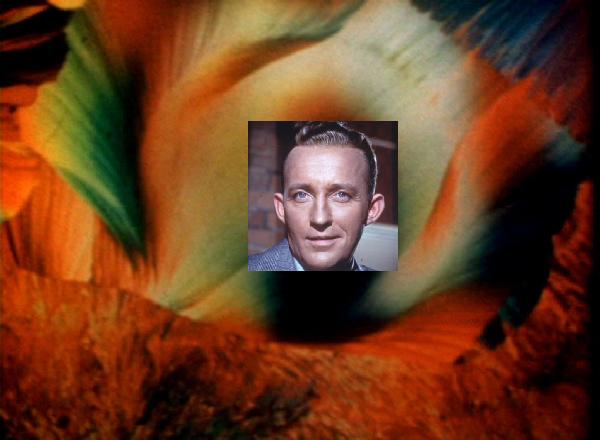
There is a good reason for Bing Crosby's tremendous popularity as a crooner. Science has discovered that his voice, filmed both in color and sound by a new machine, has a healing and soothing effect on soldiers suffering from war fatigue.
There are no sharp knives or evil-tasting green pills in Dr. Crosby's kit. Bing and Dr. Cecil Stokes, psychologist and inventor of a device called Auroratone, or Music in Color, are making a new kind of sound film which is being shown to patients in military hospitals everywhere. Soothing-voice crooners have come and crooners have gone, but Bing's popularity as a star has increased with the passing of time. Recordings of his voice with Auroratone are offering an entirely new reason why. It turns out that Bing's voice has some kind of a quality that is actually healing. When it is projected to a screen synchronized with the color tapestries of this new invention, patients seem to be lifted right up off the Earth into a special little heaven of relaxation and peace. They both see and hear Bing's voice. Auroratone is not canned color, nor is it animation.
To quote Dr. Stokes: "Auroratone is painting with music. We transform music into color, then photograph it on movie-length film. To do this we bombard highly sensitized color plates with sound waves stepped up to radio frequencies. The waves produce their own pictures on the plates." Colorful forms come and go, unfolding on the screen like the petals of a flower. The patterns are there in the music all the time, but invisible to the human eye. Auroratone, synchronized with music, brings this color into vivid visibility. Strange as it may seem, a human voice may be enchanting to a strong, sound mind but can do untold damage to the sensitive structure of the mentally unstrung. From reports, Bing's voice has proven to be therapeutically perfect. The color patterns produced by his voice are rhythmic and smooth. There are no jarry transitions.
Bing Crosby and several other Hollywood stars grew interested in the use of Auroratones to treat war-damaged veterans during the Second World War. Bing and Mary Pickford helped found the Auroratone Foundation of America in 1944 by investing money and serving on its Board. Dr. Stokes served as the Foundation's chairman and technical director. Bing donated several of his recordings with organist Eddie Dunstedter to be 'colorized,' including "Ave Maria," "Home on the Range" and "Silent Night." The Foundation was non-profit and the films distributed to military hospitals to treat veterans suffering for "war fatigue," later known as PTSD. Of the approximately 15 Auroratone films only one is known to survive intact today, Bing's recording of "Oh! Promise Me," which has been restored by the Academy of Motion Picture Arts and Sciences.
More Bing FAQs ||| Bing's Home Page ||| Written by Steven Lewis